
Modern Risk Management Strategies for Small Businesses
Key Takeaways
- Understanding and identifying potential risks is the first step toward effective management.
- Developing a comprehensive risk management plan tailored to your business needs is essential.
- Regularly reviewing and updating risk management strategies ensures they remain effective.
Table of Contents
- Introduction
- Understanding Risk Management
- Identifying Potential Risks
- Developing a Risk Management Plan
- Implementing Risk Mitigation Strategies
- Monitoring and Reviewing Risk Management Practices
- Leveraging Technology in Risk Management
- Training and Educating Employees
- Conclusion
As today’s business environment evolves at a rapid pace, small businesses encounter risks at almost every turn — from financial unpredictability and compliance challenges to ever-present cybersecurity threats. Without an effective risk management program in place, a single event can impair continuity or stall growth. By proactively identifying these vulnerabilities and utilizing solutions such as business insurance coverage, entrepreneurs can effectively protect their operations, assets, and reputations.
Whether you’re managing a startup or a well-established company, having a robust framework for risk management is more than just an option. It’s a necessity for safeguarding your investment and building resilience against unexpected disruptions. Today’s small businesses must address a broader range of risk factors, particularly as digital transformation and regulatory requirements intensify.
Implementing an effective strategy goes beyond purchasing insurance or responding to crises as they arise. It calls for a comprehensive plan — one that is regularly revised, integrates technology, and involves your entire workforce. Adopting such approaches elevates not only your ability to withstand setbacks but also positions you competitively within your marketplace.
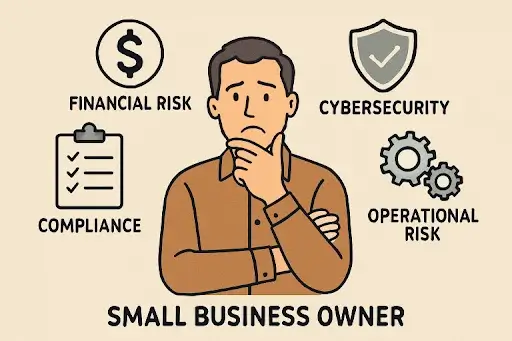
Successful risk management is a continuous improvement process. By understanding what can go wrong and knowing how to respond, you set your business up for sustainable success and durability. Developing these skills can help ensure that challenges become learning opportunities, rather than just costly mistakes.
Understanding Risk Management
Risk management for small businesses involves a systematic process: identifying threats, analyzing the likelihood and impact of these risks, and developing strategies to mitigate their consequences. The goal is to minimize potential losses while capitalizing on opportunities that can move the business forward. With smaller margins for error than larger organizations, small businesses benefit significantly from taking proactive steps that strike a balance between caution and ambition.
Effective risk management is central to long-term sustainability. Without such measures, unexpected events—whether external market shifts or internal operational failures—can drain resources, weaken competitive advantage, and even lead to business closure. Therefore, risk management is not just an administrative task but a cornerstone of prudent business leadership.
Identifying Potential Risks
Small businesses face a wide range of risks that can be grouped into several main categories:
- Financial Risks: Fluctuating cash flow, rising costs, delayed client payments, or broader economic downturns.
- Operational Risks: Equipment malfunctions, vendor disruptions, supply chain issues, or breakdowns in internal processes.
- Cybersecurity Risks: Data breaches, ransomware, phishing scams, and vulnerabilities caused by insufficient digital protections.
- Compliance Risks: Non-compliance with labor laws, health and safety codes, or industry-specific regulations.
Recent reports indicate that nearly half of small and medium-sized businesses have experienced a cyberattack, underscoring the importance of digital security as a vital component of risk management.
Developing a Risk Management Plan
Creating a risk management plan begins with a thorough risk assessment—mapping out both the likelihood and severity of potential threats. Next, prioritize these risks based on their potential impact, focusing on those that could have the most significant impact on your business’s survival. Strategies should be designed for each significant risk, detailing whether to mitigate, transfer (e.g., via insurance), accept, or avoid the risk entirely.
- Risk Assessment: Identify and assess potential internal and external threats to your operations.
- Risk Prioritization: Rank risks to allocate resources to the most pressing issues.
- Strategy Development: Specify how each risk will be addressed—whether through insurance, improved procedures, or other safeguards.
- Implementation: Put these strategies into practice, allocating roles and resources as necessary.
Implementing Risk Mitigation Strategies
Once a risk management plan is built, its effectiveness hinges on actionable strategies. To mitigate financial risks, maintain adequate cash reserves, and invest in insurance that best matches your business’s needs. Operational resilience requires robust standard operating procedures, redundancies (such as backup suppliers), and precise quality control mechanisms.
- Financial Planning: Keep adequate reserves and ensure you have appropriate insurance.
- Operational Controls: Define, document, and update critical processes to minimize disruption.
- Cybersecurity Measures: Invest in firewalls, antivirus tools, secure passwords, employee training, and consistent data backups.
- Compliance Programs: Regular audits and monitoring help your business stay compliant and adapt to new regulations.
Monitoring and Reviewing Risk Management Practices
Ongoing scrutiny and refining of risk management protocols are essential. Schedule annual or semiannual audits, review incident logs and claims, and revise risk prioritizations and mitigation strategies as needed. Post-incident reviews—regardless of the scale of disruption—yield insights that can inform stronger, more effective risk responses in the future.
- Regularly reassess existing and emerging risks in light of recent business changes or external market shifts.
- Update your risk management plans to reflect new threats or lessons learned from real incidents.
- Document improvements so the entire team understands new procedures.
Leveraging Technology in Risk Management
Technology unlocks powerful, cost-effective risk management tools for small businesses. Financial management software, for example, offers real-time visibility into cash flows, predicts receivables, and automates tax compliance. Cybersecurity tools are now often bundled with many systems, offering layered threat detection and instant alerts. Adopting cloud-based solutions and secure digital workflows can further enhance resilience by providing remote access and data recovery during unplanned disruptions.
Training and Educating Employees
Employees are often the first and last lines of defense against many types of risks—from flagging suspicious activity internally to practicing safe digital behaviors. Implement regular risk-focused training sessions that cover everything from recognizing phishing attempts to emergency protocols in the event of physical or digital breaches. Create a culture where employees are encouraged to report concerns and participate in continual improvement programs, building organizational resilience from within.
Conclusion
Modern risk management for small businesses isn’t a one-time event but a continuous cycle of identification, action, and assessment. By understanding the spectrum of risks small businesses face and integrating prevention, detection, and response measures—supplemented with tools like business insurance coverage—owners can safeguard their futures. Continue to adapt your plans, embrace new technologies, and cultivate risk-aware employees to build a thriving, sustainable business that can weather any storm. You can visit influencergonewild for more trending posts.